For someone who attends your church regularly, the building, schedule, people, and routines are familiar. You know where to park, which entrance to use, what happens during worship, where children go, and who to ask when you need help.
A first-time visitor knows none of those things.
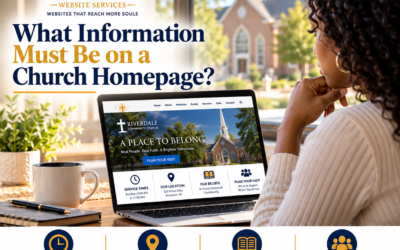
Before deciding to attend, many people will visit a church website to answer a simple question: “Would I feel comfortable visiting this church?”
They may be new to the community, looking for a church after years away, searching for a congregation for their family, or considering attending church for the very first time. Your website can help make that first step easier by providing clear, welcoming, and useful information.
1. They Want to Know When You Meet
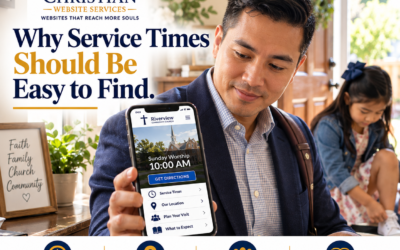
One of the first things a potential visitor needs is your service time.
This sounds simple, but service times can sometimes be surprisingly difficult to locate.
Do not make visitors search through an events calendar, download a bulletin, or navigate several pages to determine when Sunday worship begins.
Display your primary worship times prominently.
For example:
Sunday Worship: 9:00 AM & 11:00 AM
If you have multiple services with different styles or locations, briefly explain the difference and provide a link for additional details.
Also remember to update temporary schedule changes for holidays, seasonal services, or special events.
The easier this information is to find, the easier it is for someone to plan a visit.
2. They Want to Know Where You Are
Once someone knows when your church meets, the next question is usually:
“Where is it?”
Your church address should be easy to find.
Consider providing:
- Complete street address
- City and state
- Link to directions
- Map
- Parking information when needed
- Accessible entrance information when appropriate
For a large campus, it may also be helpful to tell first-time visitors which entrance to use.
Remember, instructions that seem obvious to members may not be obvious to someone who has never been on your property.
3. They Want to Know What Your Church Is Like
First-time visitors are not only gathering facts. They are trying to get a sense of the church itself.
Your website should help answer questions such as:
What kind of church is this?
What is the atmosphere like?
Who attends?
What happens on Sunday?
Would my family feel welcome?
Authentic photographs can be particularly helpful here.
Instead of relying entirely on pictures of an empty building, consider showing real church life when appropriate and when you have permission to use the photographs.
That might include worship, fellowship, children’s activities, community outreach, ministry volunteers, or people simply talking together.
Your website does not need to manufacture an image of your church.
It should help people see the church as it really is.
4. They Want to Understand What You Believe
For many visitors, beliefs are an important part of choosing a church.
Your website should provide an easy path to information about your church’s faith, mission, and beliefs.
That does not mean the homepage needs to contain your complete doctrinal statement.
A brief introduction can lead to a dedicated What We Believe page where visitors can learn more.
Avoid vague wording if it prevents people from understanding your church. At the same time, remember that some visitors may not be familiar with denominational terminology or theological language.
Clear explanations can make detailed information easier to understand without changing what your church believes.
Most importantly, the website should accurately represent the congregation and its doctrine rather than using generic language simply because it sounds appealing.
5. Parents Want Information About Their Children
For parents, children’s ministry information may be one of the most important parts of the website.
A parent visiting for the first time may want to know:
- Is children’s ministry available?
- What ages are included?
- Where do we check in?
- When should we arrive?
- Do children stay with parents during worship?
- What happens during children’s ministry?
- Who can answer questions?
- What safety or check-in procedures should we expect?
You do not have to explain every operational detail on the homepage.
Instead, provide a clear link to a children’s ministry or first-time visitor page where parents can learn more.
The goal is to reduce uncertainty.
6. They Want to Know What to Expect
People who have attended church for years may not think twice about walking into an unfamiliar sanctuary.
For someone else, it can feel intimidating.
A helpful Plan Your Visit page can answer many of the questions that first-time visitors may hesitate to ask.
For example:
- Where should I park?
- Which door should I enter?
- What should I wear?
- How long does the service usually last?
- What happens during worship?
- Is there children’s ministry?
- Is the facility accessible?
- Will I be expected to introduce myself?
- Where can I go if I have questions?
You do not need to promise visitors that every experience will happen exactly the same way.
Simply explain what someone can generally expect.
That preparation can make an unfamiliar environment feel more approachable.
7. They Want to See Who Leads the Church
Visitors may also want to know who the pastor and other key ministry leaders are.
A leadership page can include professional but approachable photographs, names, roles, and short biographies.
Depending on your church, it may also be helpful to include a brief welcome from the pastor.
Keep biographies useful and reasonably concise. Visitors generally want to understand who leads the congregation rather than read a complete professional history.
For churches with larger teams, organize leadership information so the page remains easy to navigate.
8. They May Be Looking for a Specific Ministry
Not everyone arrives at a church website for the same reason.
A college student may be looking for young-adult ministry.
A parent may be searching for children’s programs.
Someone caring for an aging parent may want information about senior ministry.
Another person may be looking for a Bible study, support group, community outreach program, men’s ministry, women’s ministry, or youth group.
A clear Ministries section can help people identify where they might connect.
Avoid simply listing ministry names that only current members understand. Add a short explanation of what each ministry does and who it serves.
9. They Want Current Information
A first-time visitor cannot easily distinguish between information that is current and information that was forgotten on the website.
If the homepage promotes an event from last year, lists a former pastor, or displays an outdated service time, the visitor may become uncertain about everything else they are reading.
You do not need to constantly redesign your website.
You do need to keep important information accurate.
Create a simple routine for periodically checking:
- Service times
- Contact information
- Leadership
- Ministry information
- Upcoming events
- Visitor information
- Giving links
- Holiday schedules
Even a quarterly website review can help identify information that needs attention.
10. They Want the Website to Work on Their Phone
A potential visitor may be looking at your website while sitting in a car, standing outside your building, or getting ready for church on Sunday morning.
Mobile usability matters.
A visitor should be able to use your website without pinching the screen, struggling with tiny buttons, or navigating a complicated menu.
Check whether important information is easy to access from a phone:
- Service times
- Address
- Directions
- Plan Your Visit
- Contact information
- Children’s ministry
- Current events
Try this yourself instead of assuming the website works well because it looks good on a desktop computer.
First-Time Visitors Are Looking for Reassurance, Not Perfection
Church websites sometimes create pressure to have the newest design, most impressive photography, or most advanced technology.
Those things are not necessarily what matters most to a first-time visitor.
Visitors are usually looking for something much simpler:
Clear information.
Current information.
A sense of what the church is like.
Answers to their questions.
An easy next step.
A small church with a simple, accurate, welcoming website can serve visitors extremely well.
The goal is not to impress people with technology.
The goal is to help people find what they need.
Look at Your Website Through a Visitor’s Eyes
One of the easiest ways to evaluate your church website is to pretend you have never attended your church.
Open the website—preferably on your phone—and give yourself a few minutes to answer these questions:
- What time is Sunday worship?
- Where is the church?
- What does the church believe?
- What should I expect?
- What is available for children?
- Who is the pastor?
- What ministries are available?
- How do I plan my first visit?
- How do I contact someone?
If those answers are easy to find, your website is already accomplishing something important.
If they are difficult to locate, you have identified practical opportunities for improvement.
A welcoming church website does not need to answer every possible question on the homepage. It simply needs to help people find the information that matters and confidently take their next step.
Help Make the First Visit a Little Easier
Before your next Sunday service, take a few minutes to experience your church website as a first-time visitor.
You may discover that small changes—moving service times, improving navigation, updating photographs, clarifying children’s information, or adding a Plan Your Visit page—can make the website more helpful.
Christian Website Services helps churches and ministries create clear, welcoming websites that make important information easier for visitors to find.
Learn more at ChristianWebsiteServices.com