For many people, their first experience with your church may not happen inside your building. It may happen while sitting at home with a phone in their hand, searching online for a church in their community.
Before attending a service, a potential visitor may want to know what your church is like, when you meet, where you’re located, what you believe, and what they should expect when they arrive.
Your church homepage has an important job: make those answers easy to find.
A homepage doesn’t need to contain everything about your ministry. In fact, trying to put everything on one page can make the website harder to use.
Instead, think of the homepage as a welcoming front door. It should provide the most important information and clearly guide visitors toward whatever they need next.
Here are four essentials that deserve prominent placement.
1. Make Your Service Times Easy to Find
One of the simplest questions a potential visitor has is:
“What time does the church meet?”
That answer shouldn’t require detective work.
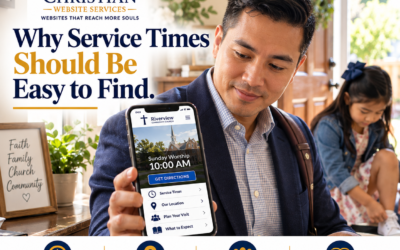
Sunday worship times should be displayed prominently on the homepage. If your church has multiple Sunday services, make each time clear. If an important midweek gathering is part of your normal schedule, that may be appropriate to include as well.
For example:
Sunday Worship — 9:00 AM & 11:00 AM
Wednesday Bible Study — 7:00 PM
Avoid making visitors search through several menus, download a bulletin, open a PDF, or scroll through an event calendar just to find your regular worship time.
Also remember to update temporary schedule changes. Holiday services, seasonal schedules, or special events can create confusion when an old time remains prominently displayed.
Clear service information helps remove uncertainty from someone’s first visit.
2. Clearly Show Your Church Location
Knowing when to come doesn’t help much if someone can’t determine where to go.
Your church’s address should be easy to find from the homepage.
Consider including the city and state along with the street address, particularly if people may discover your website through search or social media.
A link to directions or an interactive map can also be useful.
For churches with larger campuses, additional information may help:
- Which entrance should visitors use?
- Where should families with children park?
- Is accessible parking available?
- Are multiple ministries or services held in different buildings?
You don’t necessarily need all of those details on the homepage. The homepage can provide the basic location and then link visitors to a more detailed Plan Your Visit page.
The goal is simple: someone unfamiliar with your church should know where to go without having to search for the information.
3. Give Visitors a Clear Introduction to What You Believe
People looking for a church often want to understand its beliefs before attending.
Your homepage doesn’t need to contain your complete doctrinal statement. That level of information usually belongs on a dedicated What We Believe page.
Instead, consider giving visitors a brief introduction to your church’s faith, mission, or ministry identity.
You might include a short statement explaining who your church is and what guides its ministry, followed by a link such as:
Learn What We Believe →
This gives someone enough information to understand your church at a glance while allowing those who want greater detail to continue reading.
Most importantly, the language on your website should accurately represent your church’s actual beliefs. Avoid copying generic wording simply because it sounds polished.
Your website should help people understand your ministry—not create a different version of it online.
4. Give First-Time Visitors a Clear “Plan Your Visit” Button
A prominent Plan Your Visit button can be one of the most helpful elements on a church homepage.
Why?
Because someone considering your church may have questions that longtime members rarely think about.
A first-time visitor may wonder:
- Where should I park?
- Which entrance should I use?
- Where do my children go?
- Is childcare available?
- Is the building accessible?
- How long is the service?
- What happens during worship?
- What should I wear?
- Will someone greet me?
- Where do I go when I arrive?
These may seem like small details to people who attend every week, but they can feel very important to someone walking through the doors for the first time.
A good Plan Your Visit page removes some of that uncertainty.
The homepage doesn’t have to answer every question. Instead, it should make the next step obvious:
PLAN YOUR VISIT
One click can lead visitors to everything they need to feel better prepared.
Why Hiding Important Information Frustrates Visitors
Church leaders and members have one major advantage when looking at their church website:
They already know the church.
They know what time worship starts.
They know which driveway to use.
They know where children’s ministry meets.
They know what happens during a Sunday service.
A new visitor doesn’t.
This is why it’s important to evaluate your website from an outsider’s perspective.
Imagine someone arriving at your homepage and asking:
What time is worship?
Where is the church?
What does this church believe?
What should I expect when I arrive?
How quickly can that person find the answers?
If service times are buried in an online calendar, the address is only on the Contact page, beliefs require navigating through several menus, and visitor information is scattered across social media, you’re asking someone unfamiliar with your church to do unnecessary work.
That doesn’t mean the website was poorly designed intentionally. Often websites simply grow over time. New pages get added, staff members change, ministries evolve, and important information gradually becomes harder to locate.
A periodic review can make a significant difference.
Clear Information Is a Form of Digital Hospitality
Church hospitality doesn’t have to begin at the sanctuary door.
It can begin online.
A thoughtful website says to a potential visitor:
We’re glad you’re considering visiting, and we want to make it easy for you to know what to expect.
That mindset can influence many small website decisions.
Instead of asking:
“Where should we put this information?”
also ask:
“Where would a first-time visitor expect to find it?”
Instead of:
“We already have that information somewhere on the website.”
ask:
“Can someone unfamiliar with our website find it quickly?”
That change in perspective can make a church website considerably more useful.
Don’t Forget Mobile Visitors
There’s another important part of this conversation: phones.
Someone may discover your church while searching from a smartphone. They may even pull up your website in the car before walking into the building.
Check the homepage on a phone.
Can you quickly see the service time?
Can you find the address?
Can you tap the phone number or directions?
Is the Plan Your Visit button obvious?
Can you read the text without zooming?
A homepage that works beautifully on a desktop computer but becomes confusing on a smaller screen can create unnecessary obstacles.
Church Homepage Checklist
Take a few minutes to review your church homepage and check for these essentials:
- ☐ Sunday service time(s) are clearly displayed.
- ☐ The church address is easy to find.
- ☐ Visitors can easily access directions or a map.
- ☐ A short introduction to the church’s beliefs or mission is provided.
- ☐ There is a link to more detailed belief information.
- ☐ A clear Plan Your Visit button or link is available.
- ☐ First-time visitor information is easy to locate.
- ☐ Important contact information is accessible.
- ☐ The homepage works well on mobile devices.
- ☐ Current information has been reviewed for accuracy.
You don’t necessarily need a complicated homepage.
You need a helpful one.
A church homepage should make it easier—not harder—for someone to take their first step toward visiting.
Is Your Church Website Helping People Take the Next Step?
Look at your church homepage as though you’ve never seen it before.
Can you immediately find the service time, location, basic beliefs, and a clear next step?
Sometimes a few thoughtful changes can make important information much easier for visitors to find.
Christian Website Services helps churches and ministries create clear, welcoming websites designed to make important information easier to find and help people connect with the ministry.
Learn more: ChristianWebsiteServices.com